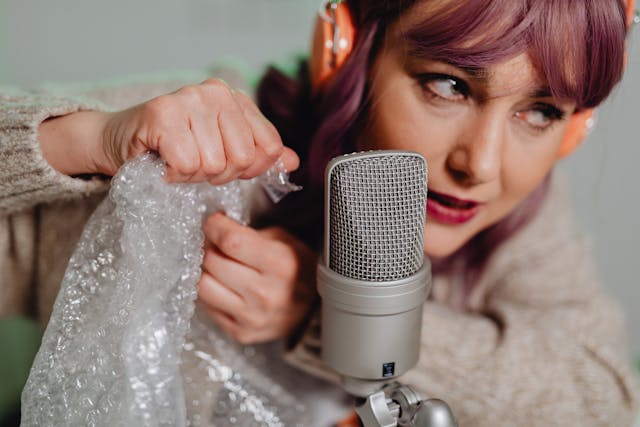
ASMR, short for Autonomous Sensory Meridian Response, became a really popular topic in the last ten years. Those tingling sensations triggered by soft sounds and whispers suddenly developed into massive online trend, with millions of viewers tuning in to relax, sleep, or destress. But what some content creators fail to understand or appreciate is that behind every soothing ASMR video or podcast is one crucial element...high-quality audio.
If you want to learn how to record ASMR audio for the best results, you’re in the right place. In this guide, we’ll cover everything you need to create immersive, crystal-clear ASMR recordings that captivate your listeners.
1. Understand What Makes ASMR Work
Before you record, it’s important to understand what makes ASMR so effective. ASMR relies on intimate, detailed, and delicate sounds, such as whispering, tapping, brushing, or gentle movements. These sounds often trigger “tingles” or a calming response in the listener.
Because ASMR is so sound-sensitive, your recording must capture even the tiniest audio nuances while avoiding background noise or distortion. The goal is to create an intimate experience, as if the listener is right there with you.
2. Choose the Right Microphone
The microphone is the most critical piece of ASMR equipment. For ASMR, clarity and sensitivity are everything.
-
Condenser microphones – Ideal for ASMR because they capture subtle details like breathing, fabric rubbing, and soft tapping. Popular choices include the Blue Yeti, Rode NT1-A, or Neumann TLM 102.
-
Binaural microphones – These mics record sound the way our ears hear it, creating a realistic 3D experience. Binaural mics are perfect for ASMR whispering or ear-to-ear recordings.
-
Stereo setup – If you can’t afford a binaural mic, two condenser mics in a stereo pair can still provide an immersive sound field.
Avoid dynamic microphones unless your room is completely silent, they’re less sensitive to high-frequency detail.
3. Create a Quiet and Controlled Recording Space
Noise control is everything in ASMR. The microphone will pick up the faintest hum, so make sure your environment is silent.
-
Turn off all background noise – Fans, air conditioners, fridges, and even computer fans can ruin your recording.
-
Record during quiet hours – Early morning or late at night often works best.
-
Treat your space acoustically – Use soft furnishings, blankets, or acoustic foam to absorb reflections and echo.
-
Avoid large rooms – Smaller, carpeted spaces produce less reverb and sound more intimate.
Your goal is to make the listener feel like they’re in the same space as you, not in a noisy room.
4. Set Up Your Equipment Properly
Once your recording environment is ready, it’s time to set up your gear:
-
Place your microphone on a stable stand with a shock mount to eliminate vibrations.
-
Use a pop filter or foam windscreen to soften plosives (like “p” and “b” sounds).
-
Record at 24-bit / 48 kHz for the best quality and detail.
-
Maintain 6–10 inches of distance from the mic, depending on your voice and style.
Always wear closed-back headphones to monitor your sound as you record.
5. Focus on Mic Technique
The way you use your microphone is just as important as the mic itself. In ASMR, mic technique creates intimacy.
-
Whisper gently and consistently – Avoid sharp breaths or sudden loud sounds.
-
Experiment with directionality – Move slightly from left to right for spatial depth.
-
Use subtle triggers – Soft tapping, page turning, hair brushing, or gentle scratching can enhance the ASMR experience.
-
Avoid handling noise – Any accidental touch or bump will sound loud through sensitive microphones.
Practice your mic technique before recording your full session to avoid unwanted noise.
6. Record Clean, Raw Audio
ASMR recordings should sound natural and pure. Avoid applying heavy effects or filters while recording. Instead, aim for clean, raw audio captures that you can lightly enhance during post-production.
Check your input levels—aim for peaks between -12 dB and -6 dB to prevent clipping. Keep your recording consistent, and stop immediately if you hear background noise (cars, footsteps, or air conditioning).
7. Edit with Care
After recording, listen through headphones and clean up your audio:
-
Remove background hum using noise reduction tools (like iZotope RX or Audacity’s noise removal).
-
Cut out clicks, pops, and gaps between triggers.
-
Apply light compression to balance levels without squashing dynamics.
-
Add subtle EQ to remove harsh frequencies and enhance warmth.
-
Normalize your final track to a comfortable level without distortion.
Remember: less is more. Over-editing can make ASMR sound artificial or fatiguing.
8. Enhance the Experience
Once your recording is clean, consider adding gentle touches that elevate the experience:
-
Stereo imaging – Pan sounds left and right to mimic real-world movement.
-
Reverb (very subtle) – Add a touch of room sound for realism, but never overdo it.
-
Layered triggers – Combine soft whispers with ambient sounds like rain, pages, or nature to create depth.
Keep the final output soothing, immersive, and consistent in volume.
Recording ASMR audio takes patience, precision, and practice. Every sound counts, from the softest breath to the gentlest tap. By using a quality microphone, controlling your environment, and focusing on detail, you can create recordings that truly relax and engage your listeners.
Remember, ASMR isn’t just about sound, it’s about feeling. Capture emotion, create intimacy, and your audience will keep coming back for more.